
Why Employees Don't Use Your Wellness Benefits (51% Think It's Wellness Washing)
51% of employees believe their company's wellness initiatives are more about optics than outcomes. Here's how to tell if your program is wellness washing, and what to do instead.

51% of employees believe their employer's wellness initiatives are performative. Not "could be better." Not "needs improvement." Performative -- as in, designed to look good rather than do good.
That number comes from Deloitte's 2024 Workplace Well-Being Survey, and it should alarm every People leader who has signed off on a wellness budget in the past three years. When more than half your workforce views your wellness program as theater, you do not have an engagement problem. You have a trust problem.
Here is the thesis: The gap between what companies spend on wellness and what employees actually experience is so wide that it has its own name -- wellness washing. And until People leaders learn to recognize it in their own programs, no amount of budget will fix the credibility deficit.
What wellness washing actually is
Wellness washing is the corporate wellness equivalent of greenwashing. It is the gap between wellness optics and wellness outcomes -- between what a company says about employee wellbeing and what employees actually experience day-to-day.
It is not always intentional. Most People leaders genuinely want to reduce burnout and improve employee health. The problem is that the standard corporate wellness playbook -- app subscriptions, stipends, awareness weeks, EAP hotlines -- creates the appearance of caring without changing the conditions that cause distress.
Gallup's 2025 State of the Global Workplace report found that only 23% of employees worldwide are engaged at work. Global employee wellbeing dropped for the second consecutive year. Companies are spending $68 billion annually on wellness. The numbers are moving in opposite directions.
That disconnect is what employees are reacting to. They can see the wellness poster in the break room. They can also see the 60-hour work expectations. They are not confused about which one is real.
Four patterns that qualify as wellness washing
You will not find "wellness washing" in your program documentation. It shows up in patterns -- recurring gaps between stated values and lived experience. Here are the four most common archetypes.
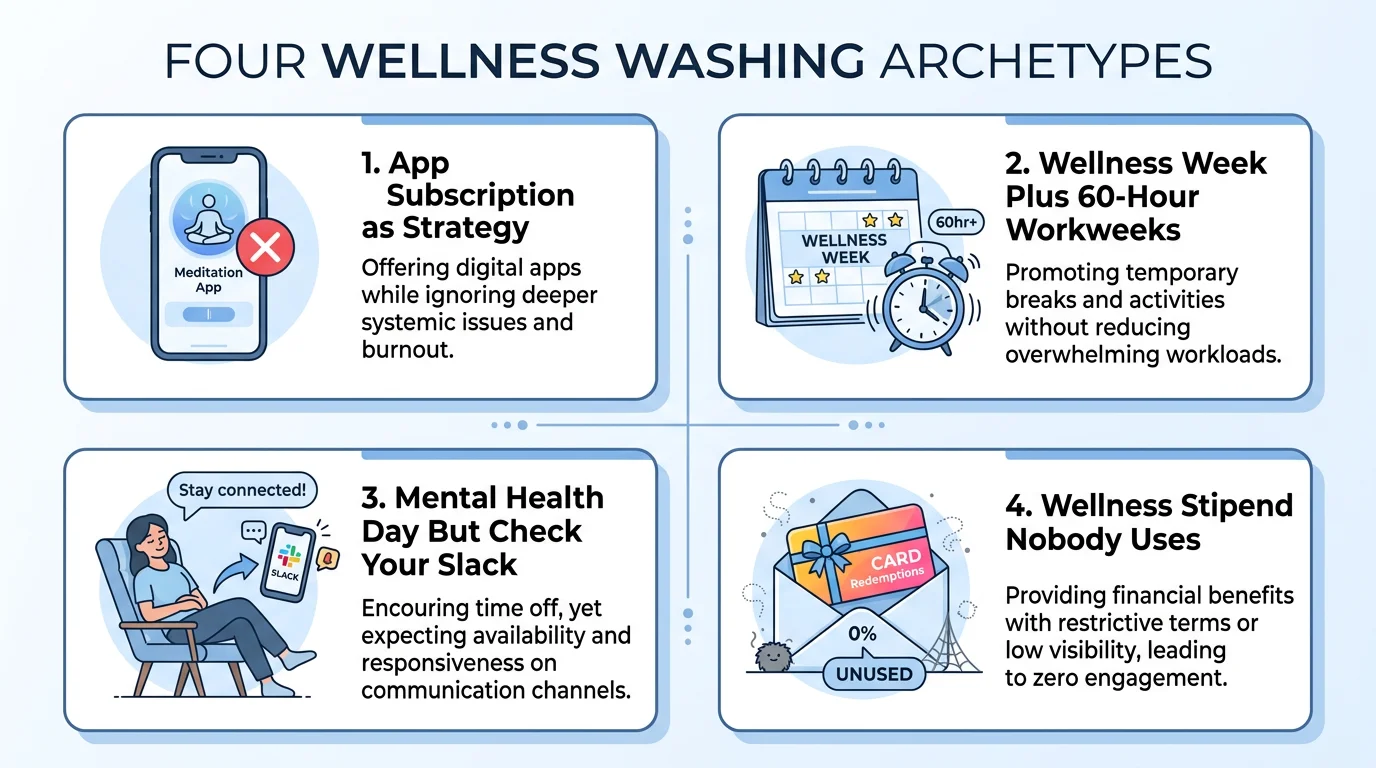
1. The "app subscription as strategy" company
This company provides Headspace or Calm licenses to every employee and calls it a wellness program. The vendor sends a nice dashboard showing how many accounts were created. Leadership references it in recruiting decks and all-hands slides.
What the dashboard does not show: 95.3% of those users abandoned the app within 30 days. The per-seat cost is being paid for accounts that generate zero sessions per month. The employees who need stress relief most -- the ones drowning in workload -- are the least likely to open a meditation app on their own time.
That is a line item, not a wellness program. The retention data on meditation apps makes this painfully clear: individual-willpower-dependent tools do not work at scale. Buying licenses is not the same as reducing stress.
2. The "wellness week but 60-hour workweeks" company
This company runs an annual Mental Health Awareness Week. There are webinars. There is a Slack channel with resources. There is a speaker. Maybe there is a team yoga session.
The other 51 weeks, the same company expects 60-hour work weeks, treats weekends as soft deadlines, and promotes the people who sacrifice the most personal time.
The APA's 2024 Work in America Survey found that 77% of Americans experienced work-related stress in the past month, with workload cited as the number one contributor. One awareness week cannot offset 51 weeks of the conditions that cause the stress. Employees know this. When they see the "Wellness Wednesday" Slack post from the same leadership that expects responses at 10 PM, the conclusion they draw is not charitable.
3. The "mental health day but check-your-Slack" company
This company offers dedicated mental health days. It is a generous-sounding policy. Some companies offer an additional 2-4 days per year specifically for mental health.
But the unwritten culture says: stay reachable. Check Slack. Be available if something urgent comes up. The "mental health day" becomes a slightly less productive version of a regular workday, taken at home, with ambient guilt.
Gallup's data shows that 81% of remote workers check email outside work hours and 34% check on vacation. If employees cannot truly disconnect on vacation, they certainly are not disconnecting on a mental health day. The policy exists on paper. The culture neutralizes it in practice.
4. The "wellness stipend nobody uses" company
This company allocates $50-$100 per month per employee for wellness-related expenses. Gym memberships, therapy co-pays, massage, supplements -- the list of eligible expenses is long and varied.
Utilization tells the real story. Deloitte's workplace wellbeing research found that 68% of workers do not use the full value of their wellbeing resources because accessing them is too time-consuming, confusing, or cumbersome. We have covered in detail why wellness stipends do not reduce burnout -- the short version is that outsourcing wellbeing to individual spending decisions fails for the same reason individual wellness apps fail. The people who most need help have the least capacity to navigate the system.
Why employees don't use wellness benefits
The utilization problem is not about gratitude or awareness. Employees know the benefits exist. They are not using them for structural reasons that no amount of internal marketing will solve.
Barrier 1: Time poverty. The employees experiencing the most stress have the least time to research, sign up for, and consistently use a wellness benefit. A burned-out manager working 55 hours a week does not have bandwidth to evaluate therapy providers, schedule appointments, and submit reimbursement forms.
Barrier 2: Stigma and career risk. Deloitte's survey found that 43% of employees fear negative consequences if they disclose a mental health condition -- even at companies with visible wellness programs. When employees believe that using mental health benefits could affect how they are perceived by managers, the rational choice is to not use them.
Barrier 3: The wrong unit of intervention. Most wellness benefits target the individual. But burnout is driven by organizational factors -- workload, management quality, meeting overload, always-on culture. Giving an individual a yoga stipend to cope with an organizational problem is like giving a single swimmer a floatation device while the ship keeps sinking. It helps one person marginally. It fixes nothing systemically.
The trust deficit: what happens when employees see through it
When employees perceive wellness washing, the damage extends beyond low utilization. It actively erodes organizational trust.
A 2024 study by Workplace Intelligence and Deloitte found that 55% of employees say their employer overestimates how healthy the work environment is. That perception gap is not neutral. When leadership believes the workplace is healthier than employees experience it to be, every subsequent wellness initiative launches into a credibility vacuum.
The consequences compound. Employees become cynical about new programs before they launch. Participation in genuinely helpful offerings drops because employees cannot distinguish real initiatives from performative ones. Top performers -- the people with the most options -- leave for organizations where the culture matches the marketing.
Gallup's data ties this directly to business outcomes: disengaged employees cost the global economy $438 billion annually in lost productivity. Wellness washing does not just fail to solve burnout. It accelerates the disengagement cycle.
How to tell if YOUR program is wellness washing
Here is an honest self-assessment framework. Score yourself on each question.
1. Do your wellness offerings require individual initiative to use? If employees must opt in, download something, schedule something, or submit reimbursements on their own -- your utilization will track app-level abandonment rates. The data on this is unambiguous.
2. Does your wellness program address root causes or only symptoms? If you offer stress management training but have not audited meeting load, after-hours communication expectations, or workload distribution -- you are treating symptoms.
3. Is there a gap between your wellness policies and your actual culture? Mental health days that come with implicit expectations to stay reachable are not mental health days. Wellness budgets at companies where overwork is celebrated are not wellness budgets. The policy is not the program. The culture is the program.
4. Can you measure outcomes, not just inputs? If your wellness metrics are "number of licenses purchased" or "stipend dollars allocated" rather than "sessions completed per employee per week" or "burnout scores at the team level" -- you are measuring spending, not impact.
5. Would your employees agree with your description of your wellness program? This is the most important question. If leadership's characterization of the program and employees' lived experience are meaningfully different, the 51% perception of wellness washing is likely present in your organization.
What genuine wellness commitment looks like
Programs that actually move the needle on employee wellbeing share three structural characteristics that distinguish them from wellness washing.
Embedded, not extra
The interventions that work are built into how work already happens. A five-minute team breathing session at the start of a standup is embedded. A wellness app employees are supposed to use in their personal time is extra. The 2025 JAMA Network Open study of 1,458 employees found that adherence was the strongest mediator of outcomes -- and adherence depends on how little friction the intervention introduces.
Social, not solo
Gallup's research consistently shows that engagement is driven by team dynamics, not individual tools. Employees with a "best friend at work" are seven times more likely to be engaged. Team-based wellness practices create shared accountability and collective permission to prioritize mental health. Solo wellness benefits create recurring charges people feel guilty about.
Structural, not supplemental
Real wellness commitment means examining and changing the work conditions that cause distress -- not just offering recovery tools. It means auditing meeting load, modeling healthy boundaries from leadership, training managers, and building brief recovery into the workday rhythm.
What People leaders should do this quarter
Audit your utilization data honestly. Pull the actual usage numbers on every wellness benefit you offer. Not accounts created. Not dollars allocated. Actual sessions completed, appointments attended, resources accessed. If utilization is below 20%, the benefit is functionally decorative.
Run an anonymous perception survey. Ask employees one question: "Do you believe our company's wellness offerings genuinely improve your day-to-day work experience?" If the majority says no, you have your answer.
Shift budget from individual to team-based. Every dollar spent on individual-opt-in wellness tools competes with the 95% abandonment rate. Redirect toward interventions that are brief, social, and embedded in existing workflows.
Fix one structural issue. Pick the single highest-impact structural contributor to burnout at your company -- meeting overload, after-hours Slack expectations, workload imbalance -- and address it before launching any new wellness initiative. One real structural change will do more for trust than ten new perks.
Measure at the team level. Individual wellness metrics are noise. Team-level engagement, burnout, and participation data reveal the patterns that actually predict outcomes.
What separates wellness washing from genuine wellness commitment has nothing to do with budget size. It comes down to whether your program changes the conditions of work or just offers coping mechanisms for them.
Pauso brings 5-minute team mindfulness sessions into your existing calendar -- no app downloads, no individual accounts, no willpower required. See how it works.
Related Articles


Give your team a shared breath
Pauso joins your Zoom, Meet, or Teams call and guides a 5-minute breathwork session. No apps, no setup, flat price per team.
See plans →