Burnout Statistics 2026: What Every People Leader Needs to Know
76% of employees report burnout. The 2026 data is worse than you think. Here are the numbers every People leader needs to see.

76% of U.S. workers now report experiencing burnout at work. Not “some stress.” Not “a tough quarter.” Real burnout, the kind that degrades decision-making, drives turnover, and costs the global economy hundreds of billions of dollars every year.
That number comes from the APA’s 2024 Work in America Survey, and the trend line heading into 2026 is not improving. If you’re a People leader still treating burnout as an individual resilience problem, the data is about to make your job much harder.
Here’s my thesis, and some of you will disagree: Burnout is a workplace design failure, not a personal one. Companies that keep framing it as something employees need to “manage” with self-care apps and wellness stipends will keep hemorrhaging talent and productivity.
Let’s look at the numbers.
The headline numbers
The scale of workplace burnout is no longer debatable. Multiple large-scale surveys converge on the same conclusion: the majority of your workforce is burned out right now.
76% of U.S. workers report experiencing at least some level of burnout, with 53% reporting moderate to severe levels, according to the APA’s 2024 Work in America Survey. That same survey found 77% of Americans were stressed by work in the past month.
Deloitte’s workplace burnout survey found 77% of respondents had experienced burnout in their current job, with more than half experiencing it more than once. Among those, 91% said unmanageable stress negatively affected their work quality.
And it’s hitting the people you can least afford to lose. Gallup’s 2025 State of the Global Workplace report found that manager engagement dropped from 30% to 27% in 2024. Female manager engagement fell by seven points. Young manager (under 35) engagement fell by five points.
When your managers burn out, everything downstream breaks. Gallup’s data shows 70% of team engagement is attributable to the manager.
Generational breakdown
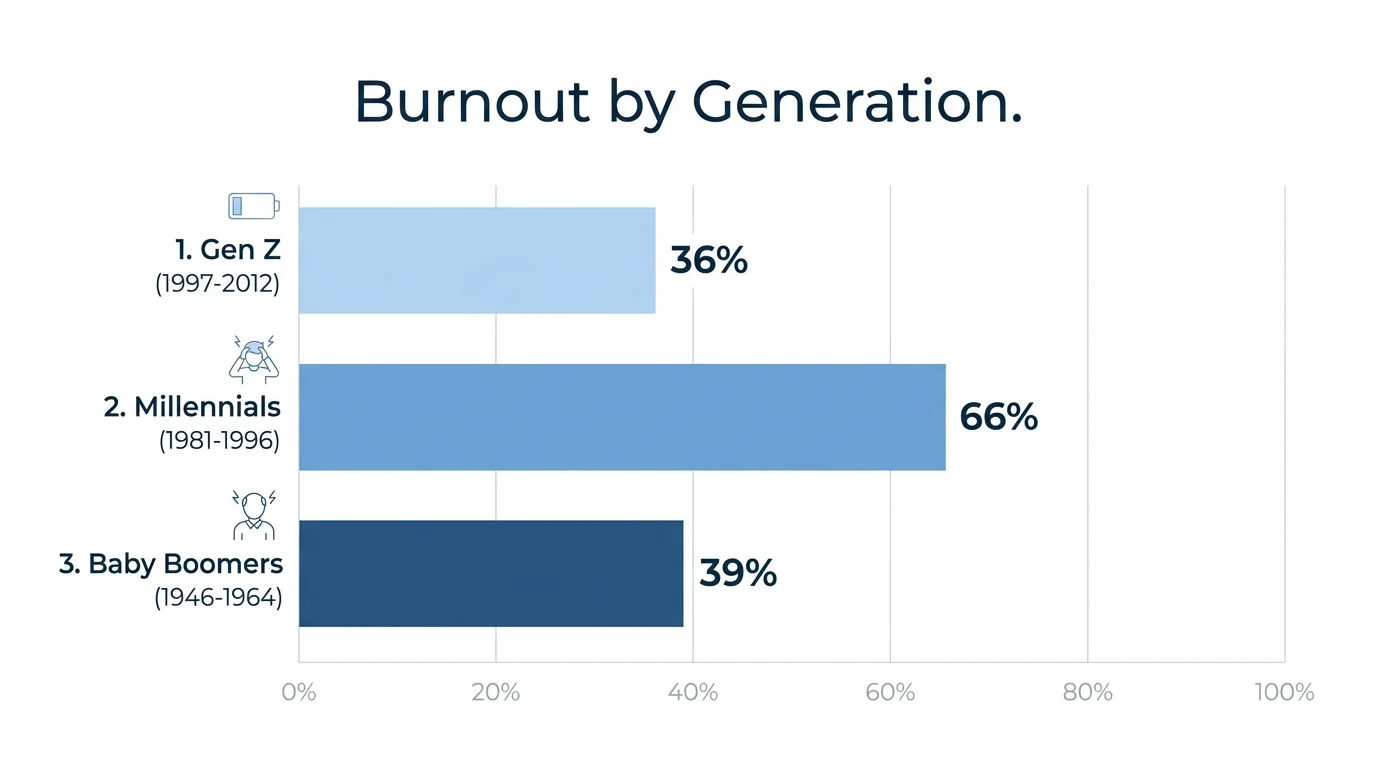
The burnout crisis isn’t distributed evenly. Deloitte’s 2025 Gen Z and Millennial Survey found that 36% of Gen Z workers feel exhausted all or most of the time, and 42% say burnout prevents them from performing at their best.
66% of millennials report significant burnout, compared with 39% of baby boomers. If your workforce skews younger (and most growing companies’ workforces do), your exposure is higher than the averages suggest.
The cost: $438 billion and counting
Burnout is a financial crisis hiding in your P&L.
Gallup’s 2025 report quantified it: the two-point drop in global employee engagement from 23% to 21% cost the world economy $438 billion in lost productivity. That’s not a projection. That’s the bill for a single year of declining engagement.
At the organizational level, Deloitte’s research shows 83% of burned-out employees say it damages their personal relationships, which circles back into absenteeism, presenteeism, and turnover. A Visier survey found 70% of employees experiencing burnout said they would leave their job because of it.
Run the math on your own team. If 76% of your employees experience burnout and 70% of those would leave because of it, you’re looking at over half your workforce as a flight risk. At average replacement costs of 50–200% of annual salary, the numbers get alarming fast.
The broader economic picture is equally stark. The WHO recognizes burnout as an occupational phenomenon, and estimates from multiple sources put the global cost between $322 billion (Deloitte’s 2024 figure) and $438 billion (Gallup’s 2025 figure), depending on what you measure.
Remote vs. in-office: nobody’s winning
If you’re hoping your return-to-office policy will fix burnout, the data says otherwise.
Remote workers report burnout at 36%. In-office workers report it at 35%. The difference is statistically meaningless. Hybrid workers come in lowest at 28%, but they’re hardly thriving either.
Gallup calls it the “remote work paradox”: remote employees show higher engagement but lower overall wellbeing. They’re more connected to their work and more stressed by it at the same time. 81% of remote workers check email outside of work hours. 63% check on weekends. 34% check on vacation.
The takeaway for People leaders: location policy is not a burnout strategy. Remote workers burn out from isolation. In-office workers burn out from commutes and interruptions. Hybrid workers burn out from context-switching. The modality isn’t the variable; the absence of recovery rituals is.
What’s not working
Here’s where the data gets uncomfortable for anyone who’s been writing checks to wellness vendors.
Individual wellness apps have a 95.3% abandonment rate within 30 days. We’ve written about this extensively. The individual motivation model is fundamentally broken. When you give someone a meditation app subscription, you’re giving them one more thing they’ll feel guilty about not using.
Wellness stipends fare no better. Giving employees $50/month to spend on “wellness” sounds generous, but there’s little evidence it moves the needle on burnout at an organizational level. The employees who use them tend to be the ones already managing their stress well. The ones who need help most are too burned out to research which yoga studio to try.
Deloitte’s own survey found that employers are “missing the mark when it comes to developing well-being programs that their employees find valuable.” The disconnect is structural: companies treat burnout as an individual consumption problem (here’s an app, here’s a stipend, here’s a webinar) when it’s actually a collective workflow problem.
What the data says actually works
The research points to three characteristics shared by interventions that actually reduce burnout:
1. Brief and consistent beats long and occasional
A 2025 JAMA Network Open study of 1,458 UCSF employees found that digital mindfulness reduced perceived stress with a large effect size (Cohen d = 0.85). The standout finding: participants were prescribed 10 minutes daily but averaged just 5.2 minutes. Even at that reduced dose, they saw significant reductions in stress, burnout, and anxiety that persisted at 4-month follow-up.
Five minutes. Not an hour-long workshop. Not a weekend retreat. Five minutes, done consistently.
2. Team-based beats individual
The same JAMA study found meaningful improvements in work engagement (Cohen d = 0.31) alongside stress reduction. Research from Brown University shows that group-based mindfulness provides approximately 7% additional benefit over identical individual practice, a phenomenon they call the “social presence effect.”
This tracks with what behavioral science has long established: social commitment is a stronger driver of sustained behavior than individual motivation. When a wellness practice is something your team does together, it shifts from optional self-improvement to shared ritual.
3. Embedded in workflow, not added on top
The interventions that persist are the ones that don’t require employees to carve out new time, download new apps, or make new decisions. They’re the ones that live inside existing calendar rhythms.
Gallup’s report makes the adjacent point: only 44% of managers worldwide have received any management training. When organizations invest in structured support (rather than asking managers to figure it out individually), disengagement among managers drops by half.
The pattern is the same whether you’re talking about mindfulness, management, or any other behavior change: embed it in the system, make it social, keep it brief.
What People leaders should do next
The data is clear enough. Here’s how to act on it:
Stop buying individual solutions for collective problems. If your burnout strategy is a list of apps and stipends, you’re spending money to feel like you’re doing something. Audit your current wellness spend. Ask how much of it requires individual initiative to use. That’s your vulnerability.
Build recovery into the workday structure. Don’t ask employees to find time for wellness. Put it on the calendar. Brief, team-based pauses between meetings. Five minutes of shared reset at the start of the day. These aren’t perks. They’re operational hygiene, like code reviews or sprint retros.
Measure what matters. Track engagement and burnout at the team level, not just the individual level. If one team is thriving and another is collapsing, the difference is almost certainly structural (workload, manager quality, meeting load), not a difference in individual resilience.
Fix the managers first. With 70% of team engagement attributable to the manager, burned-out managers are the single highest-leverage problem. Train them. Reduce their meeting load. Give them tools that don’t require them to be amateur therapists.
The companies that will win on retention and performance in 2026 aren’t the ones with the most generous wellness budgets. They’re the ones that stopped treating burnout as a personal problem and started redesigning how work actually happens.
Pauso brings 5-minute team mindfulness sessions into your existing calendar. No app downloads, no individual accounts, no willpower required. See how it works.
Related articles



Wellbeing your team will actually use
Pauso is a short breathwork reset on your team’s calendar. Flat price per company, not per seat, and nothing for anyone to install.