
The $322 Billion Burnout Problem: What It's Actually Costing Your Company
Employee burnout costs between $322B and $438B globally per year. Here's exactly how it hits your P&L, and the math for calculating your own exposure.

$322 billion. That's Deloitte's estimate for the annual global cost of employee burnout. Gallup puts it even higher at $438 billion, based on the productivity gap created by the two-point drop in global engagement from 23% to 21%.
Pick whichever number you want. Either way, burnout is a financial crisis that most companies cannot see because it is distributed across turnover, healthcare, productivity loss, and innovation decay, none of which show up on a single spreadsheet.
Here is the thesis: Most People leaders know burnout is bad. Very few can articulate what it costs in dollars. Until you can put a specific number in front of your CFO, burnout will keep losing the budget fight to initiatives with clearer ROI. This article gives you the math.
The four cost categories
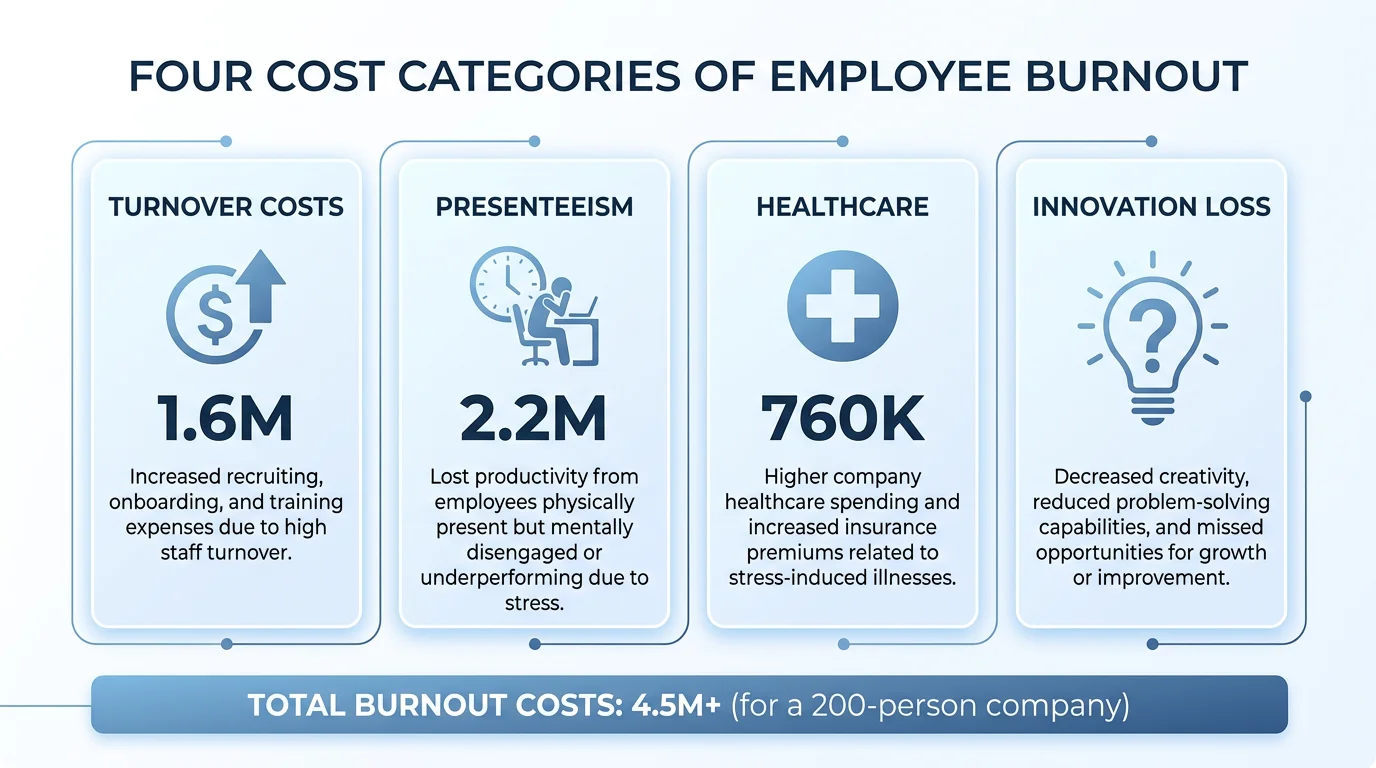
Burnout does not hit your bottom line in one obvious way. It shows up in four distinct buckets, each compounding the others. If you are only tracking one (usually turnover), you are massively underestimating your exposure.
1. Turnover: the cost everyone sees (too late)
This is the most visible damage. SHRM's research puts the cost of replacing an employee at 50% to 200% of their annual salary, depending on seniority and specialization. For a mid-level employee earning $85,000, that is $42,500 to $170,000 per departure.
Now connect that to the burnout prevalence data. With 76% of U.S. workers reporting burnout and Visier's survey finding 70% of burned-out employees would leave their job because of it, you are looking at over half your workforce as a flight risk.
For a 200-person company with an average salary of $80,000, even a conservative turnover bump of 10 percentage points attributable to burnout translates to roughly $800,000 to $3.2 million per year in replacement costs. And that is before you count the institutional knowledge walking out the door.
2. Presenteeism: the cost nobody measures
Absenteeism gets tracked. Presenteeism (showing up but operating at 50% capacity) does not. And that is a problem, because presenteeism costs employers approximately three times more than absenteeism, according to research published in the Journal of Occupational and Environmental Medicine.
Gallup's data reinforces this: disengaged employees (the category that maps closely to burnout) show 18% lower productivity, 37% higher absenteeism, and 15% lower profitability than their engaged counterparts. They are physically present but mentally checked out.
A burned-out marketing manager does not stop coming to work. They stop having the best idea in the brainstorm. They stop catching the error before it ships. They stop mentoring the junior hire who was going to be great. The cost is real. It is just invisible in your reporting.
3. Healthcare: the cost that compounds
Burned-out employees are less productive and more expensive to insure. The APA's 2024 Work in America Survey documented that employees experiencing burnout report significantly higher rates of anxiety, depression, and physical health complaints.
Research in BMC Public Health found that employees with high burnout scores had healthcare expenditures 46% higher than their non-burned-out peers. For a company spending $15,000 per employee per year on healthcare, that is an additional $6,900 per burned-out employee annually.
With 76% of your workforce reporting burnout at some level, these excess healthcare costs accumulate fast. For a 200-person company, even a moderate estimate puts the excess healthcare burden at $500,000 to $1 million per year.
4. Innovation loss: the cost you cannot calculate
This is the hardest to quantify and potentially the most damaging. Burned-out teams do not take creative risks. They default to safe, repeatable, mediocre work.
Harvard Business Review research found that burnout reduces cognitive flexibility, the mental capacity required for creative problem-solving, strategic thinking, and innovation. Chronically stressed employees show measurable declines in executive function, working memory, and the ability to generate novel solutions.
You will never see "failed to innovate because everyone was too burned out" in a quarterly report. But the competitor who ships the feature your team was too depleted to envision? That shows up eventually.
The burnout cost calculator: your company's number
Here is a framework to estimate what burnout costs your specific organization. The math is deliberately conservative.
Step 1: Estimate your burnout-attributable turnover cost
- Team size: [your number]
- Burnout rate: ~76% (APA national average)
- Percentage of burned-out employees actively considering leaving: ~70% (Visier)
- Incremental turnover rate attributable to burnout: ~10-15%
- Average replacement cost: 100% of annual salary (midpoint of SHRM range)
- Formula: Team size x 0.10 x average salary = burnout turnover cost
Step 2: Estimate your presenteeism cost
- Number of burned-out employees: Team size x 0.76
- Productivity loss per burned-out employee: ~18% (Gallup)
- Formula: Burned-out employees x average salary x 0.18 = presenteeism cost
Step 3: Estimate your excess healthcare cost
- Burned-out employees: Team size x 0.76
- Excess healthcare cost per burned-out employee: ~$4,000-$6,900
- Formula: Burned-out employees x $5,000 = excess healthcare cost
Step 4: Add it up
For a 200-person company with an $80,000 average salary, the conservative estimate looks like this:
- Turnover: 200 x 0.10 x $80,000 = $1,600,000
- Presenteeism: 152 x $80,000 x 0.18 = $2,188,800
- Healthcare: 152 x $5,000 = $760,000
- Total: $4,548,800 per year
That is $4.5 million. For a 200-person company. And this estimate does not include innovation loss, manager time spent on performance issues, or the cultural damage of having a majority-burned-out workforce.
Run these numbers for your own team. Then bring them to your next leadership meeting.
The compounding effect: burnout is contagious
Here is the part that makes the cost calculation even worse: burnout cascades.
Gallup's 2025 data shows that 70% of team engagement variance is attributable to the manager. When managers burn out (and manager engagement dropped from 30% to 27% in the latest data), their entire team's engagement collapses with them.
This is measurable, not metaphorical. A burned-out manager makes worse decisions about workload distribution, provides less coaching, and models the always-on behavior that burns out their reports. One burned-out manager can degrade the performance and wellbeing of 8-12 direct reports.
If you are not sure whether burnout has spread beyond a few individuals on your team, the early warning signs are often visible before the resignation letters start arriving.
The contagion effect means that burnout costs compound nonlinearly. You cannot treat it as a simple per-employee cost. It is more like an infection rate, and the longer you wait to intervene, the more expensive the cure becomes.
The ROI of prevention vs. replacement
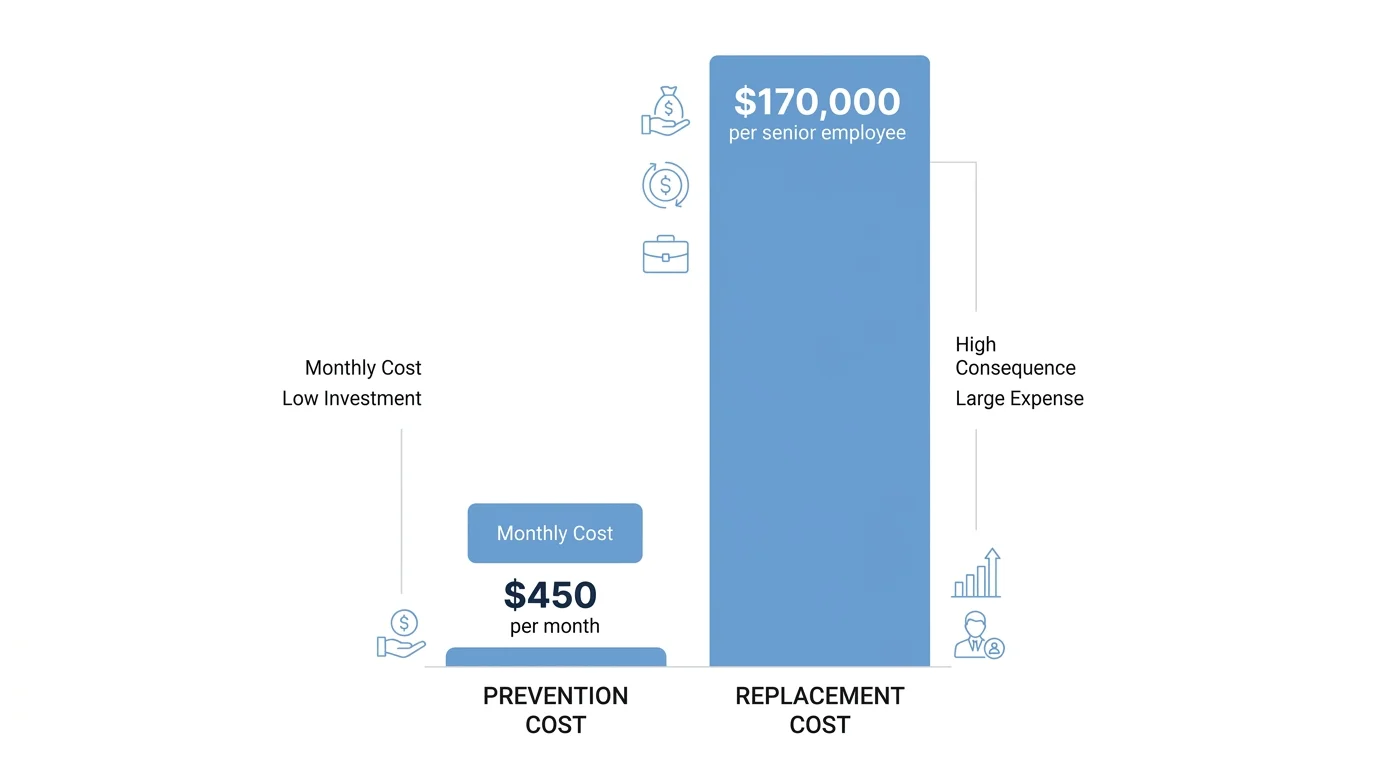
Here is the business case in its simplest form: prevention is cheaper than replacement.
The JAMA Network Open study from UCSF demonstrated that brief mindfulness interventions (as short as 5-10 minutes daily) reduced burnout with a meaningful effect size (Cohen's d = 0.39) and improved work engagement. The intervention cost was minimal. The reduction in stress, burnout, and disengagement translated directly to reduced turnover risk and improved productivity.
Compare the cost of a preventive intervention to the cost of replacing even one senior employee ($170,000+). The math is not close.
But the intervention has to actually work. And this is where most corporate wellness spending goes wrong. Companies pour money into wellness stipends and individual app subscriptions, programs that look good on paper but have abysmal utilization rates. 95.3% of people abandon individual meditation apps within 30 days. You are lighting money on fire and calling it an engagement strategy.
The interventions that actually move the needle share three characteristics: they are brief (under 10 minutes), team-based (social accountability, not individual willpower), and embedded in existing workflows (part of the calendar, not another to-do). For a comprehensive breakdown of what works, see our guide to reducing burnout in teams.
Making the business case to leadership
If you are a People leader reading this, you already know burnout is a problem. The challenge is getting your executive team to fund the solution. Here is how to frame it.
Lead with the number, not the narrative. "Our employees are stressed" gets sympathy. "$4.5 million per year in burnout-attributable costs" gets budget. Run the calculator above with your own data and present the dollar figure.
Benchmark against industry data. Current burnout statistics give you the ammunition to show this is not anecdotal. Reference the APA, Gallup, and Deloitte data. Your CFO trusts numbers from recognized institutions.
Show the asymmetry. Prevention costs pennies on the dollar compared to replacement. A team-based mindfulness program might cost a few hundred dollars per month. Replacing a single senior engineer costs $150,000+. Frame it as risk mitigation, not a wellness perk.
Propose a pilot, not a program. Don't ask for a company-wide rollout. Ask for a 90-day pilot with one or two teams. Measure engagement, retention intent, and self-reported burnout before and after. Let the data make the case for expansion.
Connect to metrics leadership already tracks. Turnover rate. Time-to-fill. eNPS. Sick days. These are business metrics that burnout directly degrades, not wellness metrics. Frame your intervention as a lever on numbers they already review quarterly.
The companies that will retain their best people in 2026 will be the ones that stopped treating burnout as an individual resilience problem and started treating it as an organizational design cost with a clear, calculable, and preventable price tag.
Pauso brings 5-minute team mindfulness sessions into your existing calendar. No app downloads, no individual accounts, no willpower required. See how it works.
Related Articles



Give your team a shared breath
Pauso joins your Zoom, Meet, or Teams call and guides a 5-minute breathwork session. No apps, no setup, flat price per team.
See plans →