
Why 95% of People Abandon Meditation Apps (And What Actually Works)
The meditation app industry has a dirty secret: almost everyone quits. New research reveals why individual apps fail and how team-based approaches are changing the game.

Here's a number that meditation app companies don't want you to see: 95.3% of users abandon their meditation practice within 30 days of downloading an app.
That's not a typo. Nearly everyone who downloads Headspace, Calm, or any other meditation app stops using it within a month.
But why? And more importantly, what can we do about it?
The individual motivation problem
The core issue isn't the apps themselves. Many are beautifully designed with excellent content. The problem is the fundamental assumption they're built on: that individuals can sustain a daily meditation habit through willpower alone.
This assumption ignores decades of behavioral science research. Here's what we actually know about habit formation:
Willpower is a depleting resource
Studies from Case Western Reserve University show that self-control operates like a muscle that fatigues with use. After a demanding workday, the mental energy required to sit down and meditate simply isn't there.
Accountability matters more than motivation
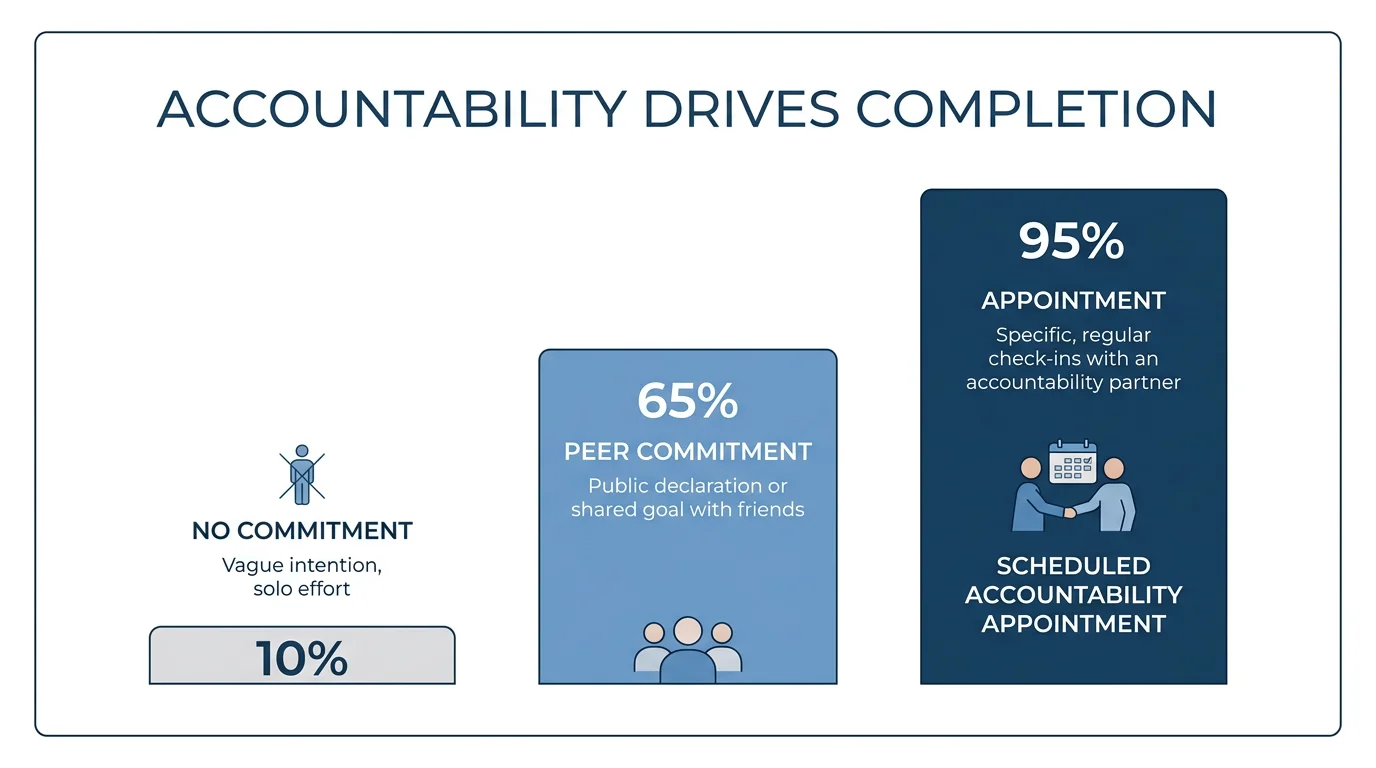
Research published in the American Society of Training and Development found that people are 65% more likely to meet a goal after committing to another person. That number jumps to 95% when they have a specific accountability appointment.
Social rituals stick better than solo habits
A meta-analysis in Health Psychology Review found that behaviors practiced in social contexts show significantly higher long-term adherence rates than individual practices.
What the research says about group mindfulness
When mindfulness moves from individual practice to team ritual, everything changes:
The UCSF study
A 2025 JAMA Network Open study of 1,458 employees at UCSF found that digital mindfulness reduced perceived stress by 27% with a large effect size (Cohen d = 0.85). The study also found that those who meditated just 5-10 minutes daily saw the greatest benefits, proving you don't need lengthy sessions to see real results.
Burnout and work engagement
The same JAMA study found significant reductions in burnout (Cohen d = 0.39) and improvements in work engagement that persisted at 4-month follow-up. Employees reported feeling less exhausted, less cynical, and more dedicated to their work.
The "social boost" effect
Research from Brown University demonstrated that practicing mindfulness in a group setting provides approximately 7% additional benefit compared to individual practice of the same duration. They termed this the "social presence effect."
Why short sessions win
Another counterintuitive finding: 5-minute sessions can be as effective as 20-minute sessions for workplace stress reduction.
The key is consistency over duration. A study in Behaviour Research and Therapy found that brief, daily mindfulness interventions produced equivalent outcomes to longer, less frequent sessions, with significantly higher adherence rates.
This makes sense when you think about it. A 5-minute team pause is:
- Easy to schedule
- Low commitment, high consistency
- Doesn't disrupt workflow
- Feels like a break, not a chore
The calendar integration advantage
The most successful workplace wellness interventions share one characteristic: they're embedded in existing workflows rather than added on top of them.
When mindfulness becomes a calendar meeting rather than an app notification:
- It has a time slot. You're not hoping to "find time" for meditation.
- Others are expecting you. Social commitment creates natural accountability.
- It's visible to your team. The practice becomes normalized, even celebrated.
- No decision fatigue. You don't have to choose to meditate; you just show up.
Where workplace mindfulness is heading
The meditation app model is broken because it puts the entire burden of behavior change on the individual, not because the apps themselves are bad.
The teams seeing real results are those who've shifted from "individual wellness app" to "shared team ritual."
Instead of asking each employee to build a solo meditation habit, successful organizations are:
- Creating 5-minute mindfulness moments at the start of meetings
- Scheduling brief team resets between intensive work blocks
- Building shared rituals that require no individual willpower
The bottom line
If you've tried meditation apps and "failed," you haven't failed at all. You've simply proven that the individual app model doesn't work for most people.
The solution is to try differently: with your team, in short sessions, integrated into your existing calendar.
Because the best meditation practice isn't the most sophisticated app or the longest session. It's the one you actually do.
Ready to try a different approach? Learn how Pauso brings team mindfulness to your existing calendar with zero app downloads required.
Related Articles


Give your team a shared breath
Pauso joins your Zoom, Meet, or Teams call and guides a 5-minute breathwork session. No apps, no setup, flat price per team.
See plans →