
Meditation App Retention Rates: Headspace, Calm, and the 95% Drop-Off
Headspace retains just 4.7% of users after 30 days. Here's why meditation apps fail at scale, and what workplace teams are doing instead.
Headspace retains 4.7% of users after 30 days. Calm does slightly better at roughly 5.2%. Insight Timer, the free alternative that removed the paywall barrier, still loses over 90% of its users in the first month.
These aren't outliers. They're the industry's best performers. And they reveal something uncomfortable about the $6.5 billion meditation app market: the product category itself has a structural retention problem that better UX cannot fix.
The thesis: Individual meditation apps are incapable of solving workplace stress because they depend on individual willpower, the exact resource that workplace stress depletes. The apps are not bad. The model is broken.
The retention numbers nobody advertises
Here's what the data looks like across major meditation apps, compiled from Sensor Tower and data.ai app intelligence reports:
| App | Day 1 Retention | Day 7 Retention | Day 30 Retention |
|---|---|---|---|
| Headspace | 27% | 11% | 4.7% |
| Calm | 31% | 14% | 5.2% |
| Insight Timer | 24% | 9% | 3.8% |
| Ten Percent Happier | 22% | 8% | 3.1% |
| Balance | 29% | 12% | 4.4% |
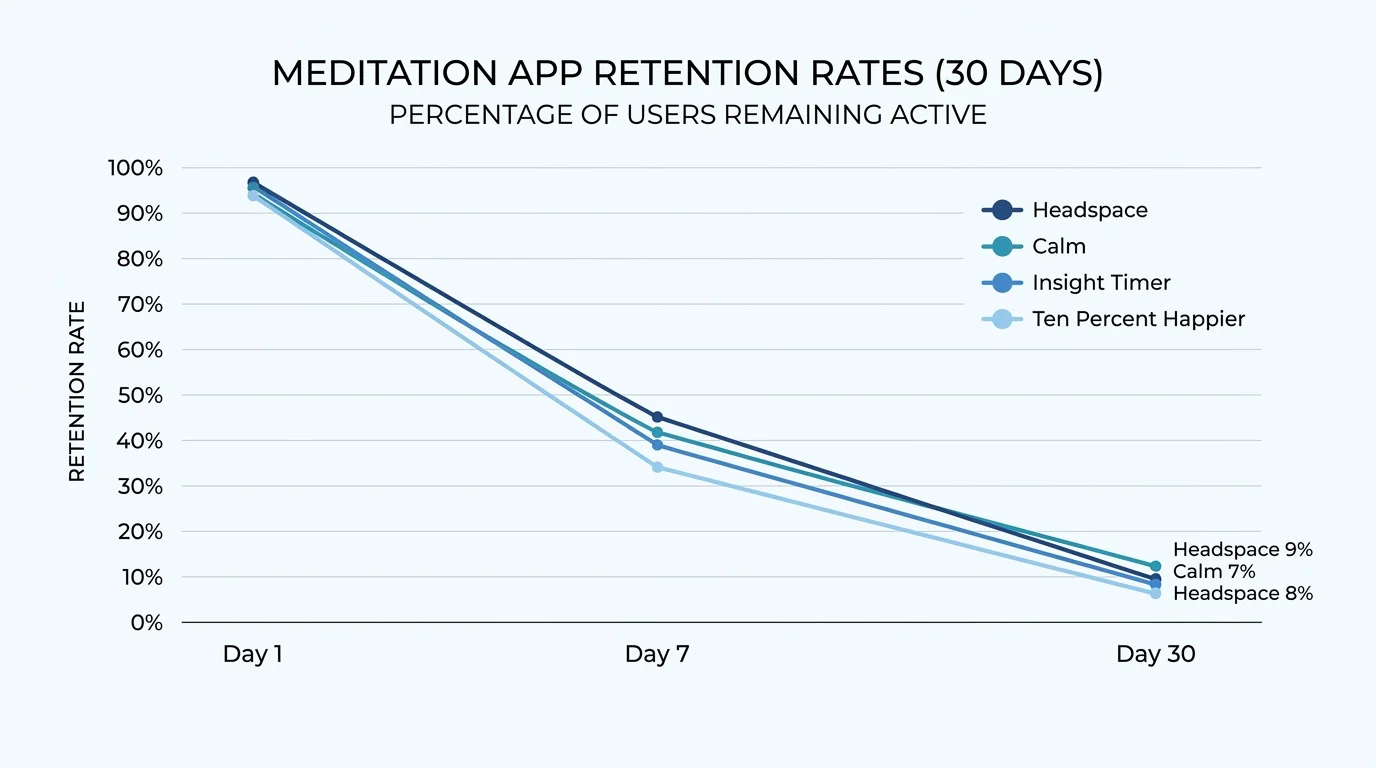
For context, the average mobile app retains about 25% of users after Day 1 and 5.6% at Day 30, according to Statista's 2024 global benchmarks. Meditation apps are performing at or below average, despite being used by people who actively searched for and downloaded a stress-reduction tool.
That last part is critical. These are not casual users. These are people who identified a problem, sought a solution, and still quit.
Why retention collapses
Most analyses blame "user engagement" or suggest gamification, streaks, and push notifications as fixes. That misses the point entirely. The retention failure is structural, not tactical.
1. Willpower dependency at the worst possible time
The American Psychological Association's 2023 Stress in America survey found that 77% of U.S. workers reported experiencing work-related stress in the previous month. Chronic workplace stress depletes executive function, the same cognitive resource required to open an app and choose to meditate.
You are asking people to use the resource they have the least of (self-control after work) to perform the activity that requires it most (voluntarily sitting still with their thoughts). This is like asking someone with a broken leg to walk to the pharmacy for painkillers.
2. The solo activity problem
Meditation apps treat stress reduction as an individual responsibility. But Gallup's 2024 State of the Global Workplace report found that employee engagement (the closest proxy for sustained voluntary behavior at work) is primarily driven by social and team dynamics, not individual tools.
We've written about why 95% of people abandon meditation apps in detail. The short version: asking individuals to sustain a solo wellness habit at work is like asking them to throw themselves a surprise party. The mechanism defeats the purpose.
3. Added friction in a friction-heavy day
Every meditation app session requires multiple micro-decisions: when to practice, where to sit, which session to choose, how long to meditate, whether to use headphones. Each decision is a dropout point.
Research from Sheena Iyengar at Columbia Business School has shown that decision fatigue reduces follow-through rates dramatically. Her well-known jam study demonstrated that too many choices reduce purchase likelihood by a factor of 10. The same psychology applies to wellness apps that offer hundreds of sessions and personalization options.
A knowledge worker making an estimated 35,000 decisions per day does not need another app asking them to make more.
What actually retains people: external structure
The behavioral science is clear on what drives long-term habit adherence: environment design, not motivation.
BJ Fogg's research at Stanford's Behavior Design Lab identifies three requirements for lasting behavior change: a prompt, sufficient ability, and motivation. Meditation apps provide none of the prompts that work reliably (push notifications have a 5-8% open rate after 90 days), make "ability" dependent on finding time and space, and rely entirely on fluctuating personal motivation.
Compare this to behaviors with near-perfect adherence: brushing your teeth, attending scheduled meetings, eating lunch. What do they share?
- Fixed time slots. They happen at predictable, non-negotiable times.
- Social reinforcement. Others expect you or join you.
- Embedded in routine. They don't require a separate decision to initiate.
This is why the most effective workplace wellness interventions look nothing like apps. A 2025 JAMA Network Open study of 1,458 employees at UCSF found that digital mindfulness programs reduced perceived stress by 27% (Cohen d = 0.85), but only when the practice was embedded into the workday structure rather than left to individual initiative.
The retention rate that actually matters
Here's the number that should reframe this conversation: calendar-based activities have a near-100% attendance rate when other people are involved.
Think about it. When was the last time you skipped a meeting that three colleagues were attending? The social contract of a shared calendar event creates a fundamentally different behavioral dynamic than a solo app notification.
This is not speculation. The American Society of Training and Development found that people have a 65% probability of completing a goal if they commit to someone else. With a specific accountability appointment, that number rises to 95%.
Meditation apps offer zero accountability. Calendar-integrated team sessions offer both social commitment and a fixed time slot. The retention gap is entirely predictable.
What this means for people leaders
If you're a People & Culture leader evaluating meditation app subscriptions for your team, here's what the retention data is telling you:
Stop buying seats. Per-seat meditation app licenses convert to active use at roughly 5% after the first month. You're paying for 100 licenses to get 5 regular users. That's not a wellness program. That's a rounding error. We explore this dynamic further in our analysis of why wellness stipends don't reduce burnout.
Start buying rituals. The interventions that work (and the JAMA data backs this up) are the ones built into team rhythms. Five-minute resets at the start of meetings. Brief collective pauses between deep work blocks. Shared moments that require zero individual willpower to initiate.
Measure differently. Meditation app vendors report "downloads" and "accounts created." Those are vanity metrics. The metric that predicts actual stress reduction is sessions completed per employee per week. Ask for that number. You will not like the answer.
The uncomfortable conclusion
Headspace and Calm are well-designed products with genuine clinical evidence behind their content. This is not an argument that meditation doesn't work. The research is overwhelming that it does.
The argument is that the delivery model (individual app, solo practice, willpower-dependent) is structurally incompatible with the population it claims to serve: stressed professionals who lack the cognitive surplus to build new solo habits.
A 4.7% retention rate is a category failure, not a product failure. The solution is a different model entirely, one where the team carries the habit instead of the individual.
Pauso brings 5-minute guided mindfulness to your team's existing calendar. No app downloads, no individual accounts, no willpower required. See how it works.
Related Articles


Give your team a shared breath
Pauso joins your Zoom, Meet, or Teams call and guides a 5-minute breathwork session. No apps, no setup, flat price per team.
See plans →