
Corporate Wellness Programs in 2026: What Actually Works (And What's Wellness Washing)
Companies will spend $68B on corporate wellness in 2026 while burnout hits record highs. Here's a research-backed guide to what actually works (and what's just expensive optics).

The corporate wellness industry will exceed $68 billion in global spending in 2026, according to Fortune Business Insights. In the same year, 76% of U.S. workers report experiencing burnout, manager engagement is at a decade low, and the WHO classifies workplace stress as a global health epidemic.
These two facts should not coexist. If corporate wellness programs worked, the $68 billion should be buying something. Instead, we have an industry that is growing in revenue while failing at its stated purpose.
Here is the thesis of this article: The majority of corporate wellness spending in 2026 is wellness washing: programs that serve the employer's brand more than the employee's health. The programs that actually reduce burnout, improve engagement, and deliver measurable ROI share three characteristics that most wellness vendors do not offer: they are brief, social, and embedded in how work already happens. If you are a People leader evaluating wellness spend this year, this guide will save you from funding another expensive placebo.
The disconnect: $68 billion in, record burnout out
Let's start with the numbers that should make every CHRO uncomfortable.
Gallup's 2025 State of the Global Workplace report found that global employee engagement dropped from 23% to 21%, a decline that cost the world economy an estimated $438 billion in lost productivity in a single year. In the U.S. and Canada, 49% of employees report significant daily stress. Deloitte's Workplace Well-Being Survey found that 77% of professionals have experienced burnout at their current job, with 91% saying unmanageable stress degrades their work quality.
Meanwhile, corporate wellness spending keeps climbing. Companies are buying more meditation app licenses, more gym reimbursements, more EAP contracts, more wellness stipends. The supply side of the market is thriving. The demand side (actual employee wellbeing) is deteriorating.
The problem is not timing. Many of these interventions have been deployed at scale for a decade. The data is in. The spending and the outcomes are moving in opposite directions.
The wellness washing problem
The term "wellness washing" describes companies that invest in visible wellness programs primarily for recruitment marketing, employer branding, and ESG optics, without meaningfully addressing the structural conditions that cause employee distress.
Deloitte's 2024 Workplace Intelligence study quantified the perception gap: 55% of employees believe their employer overestimates how healthy the work environment actually is. And 43% of employees fear negative consequences if they disclose a mental health condition, even at companies with prominent wellness programs.
Wellness washing is not always cynical. Many leaders genuinely want to help. But the effect is the same: the company gets to say "we invest in employee wellbeing" while employees experience no material improvement. We've catalogued common wellness washing patterns that People leaders should watch for. The gap between stated intention and structural impact is often wider than leadership realizes.
How to spot wellness washing
There are reliable signals. If a company's wellness program requires individual opt-in during personal time, depends on employee willpower to sustain, does not address workload or management practices, and is primarily featured in recruiting materials, it is almost certainly wellness washing. The program exists to make the company look good, not to make employees feel better.
The tell is in the utilization data. According to Deloitte's research, 68% of workers do not use the full value of their wellbeing resources because accessing them is too time-consuming, confusing, or cumbersome. If two-thirds of your workforce isn't using what you're offering, you don't have a wellness program. You have a press release.
What the research says doesn't work
Before examining what works, it's worth being precise about what the evidence says does not work. Two categories of intervention have particularly strong negative evidence.
Individual wellness apps
The meditation and wellness app market is valued at over $6.5 billion. It has a catastrophic structural problem: 95.3% of users abandon their practice within 30 days of downloading an app. We've analyzed the retention data across major platforms. Headspace retains 4.7% of users at Day 30, Calm retains 5.2%, and free alternatives like Insight Timer perform even worse.
This is not a product quality issue. These are well-designed apps with clinically validated content. The failure is in the delivery model. Individual apps depend on personal willpower, the exact cognitive resource that workplace stress depletes. You are asking burned-out employees to use the one resource they lack (self-regulation after work) to perform an activity that requires it (voluntarily sitting still). We've explored why this model fails so consistently. The short version is that individual willpower cannot sustain behavior change when the environment actively works against it.
For People leaders, the practical implication is blunt: per-seat meditation app licenses convert to active use at roughly 5% after the first month. You are paying for 100 licenses to get 5 regular users.
Wellness stipends and reimbursements
The other popular intervention, giving employees a monthly stipend to spend on "wellness," fares no better under scrutiny.
The NBER's Illinois Workplace Wellness Study, one of the largest randomized controlled trials of corporate wellness ever conducted, tracked nearly 5,000 employees over two years. The findings were devastating: no significant effects on physical health outcomes, medical spending, absenteeism, or productivity. The 95% confidence intervals ruled out 84% of the positive effects that previous observational studies had claimed.
The problem is structural. Wellness stipends shift responsibility to the individual while preserving the work conditions that cause distress. When you give someone $75 per month to "take care of themselves," the implicit message is that their burnout is their problem to solve. The employees who redeem wellness stipends tend to be the ones who were already managing stress well. The ones who need help most are too overwhelmed to research which yoga studio to try.
What the research says actually works
The evidence is not all negative. Several large-scale studies point to interventions that genuinely reduce stress, lower burnout, and improve engagement. They share a consistent pattern.
Brief, consistent interventions beat long, occasional ones
A 2025 JAMA Network Open study from UCSF randomized 1,458 employees and found that digital mindfulness programs reduced perceived stress with a large effect size (Cohen's d = 0.85). Burnout specifically declined (d = 0.39), and work engagement improved, with results sustained at four-month follow-up.
The critical finding: participants were prescribed 10 minutes daily but averaged just 5.2 minutes. Even at that reduced dose, they saw significant and lasting benefits. Five minutes of daily practice outperformed longer, less frequent interventions across every outcome measured.
This aligns with research from Behaviour Research and Therapy showing that brief daily mindfulness sessions produce equivalent outcomes to longer sessions with significantly higher adherence. Duration is not the variable that matters. Consistency is.
For People leaders, this reframes the question entirely. You do not need to find an hour for a wellness workshop. You need to find five minutes, consistently, across teams, embedded in existing rhythms.
Team-based interventions beat individual ones
The same JAMA study found meaningful improvements in work engagement alongside stress reduction. Research from Brown University provides the mechanism: group-based mindfulness produces approximately 7% additional benefit over identical individual practice. They call this the "social presence effect": knowing others are sharing your experience amplifies its impact.
Gallup's research corroborates this from a different angle. Employee engagement is primarily driven by social and team dynamics. People with a "best friend at work" are seven times more likely to be engaged. Wellbeing interventions that include a social component outperform individual tools on every metric Gallup tracks.
The behavioral science is equally clear. The American Society of Training and Development found that people have a 65% probability of completing a goal if they commit to someone else. With a specific accountability appointment, that rises to 95%. A calendar-integrated team session provides both the social commitment and the fixed time slot. A solo app provides neither.
Embedded practices beat add-on programs
The single strongest predictor of whether a wellness intervention works is whether people actually do it. That sounds tautological, but it has a non-obvious implication: the best intervention is not the most clinically effective one in a lab setting. It is the one with the highest real-world adherence rate.
The UCSF JAMA study found that adherence was the primary mediator of outcomes. Participants who stuck with the practice got the results. Those who dropped off didn't. This means the design question for People leaders is not "which intervention has the best clinical evidence?" It is "which intervention will our employees actually do, week after week?"
The answer, consistently, is the one embedded in existing workflows. A five-minute team breathing session at the start of an existing meeting requires zero additional decisions, zero calendar Tetris, and zero individual willpower. A wellness stipend for an app used on personal time requires all three.
This is also why the problem of remote worker loneliness resists solution through optional social events. Buffer's 2024 State of Remote Work report found 25% of remote workers cite loneliness as their top challenge, and adding more Slack channels doesn't fix it. What works is synchronous, embodied, shared experience embedded in how teams already operate.
The BSE framework: evaluating any wellness program
Based on the evidence, here is a practical framework for evaluating any corporate wellness intervention. We call it BSE: Brief, Social, Embedded.
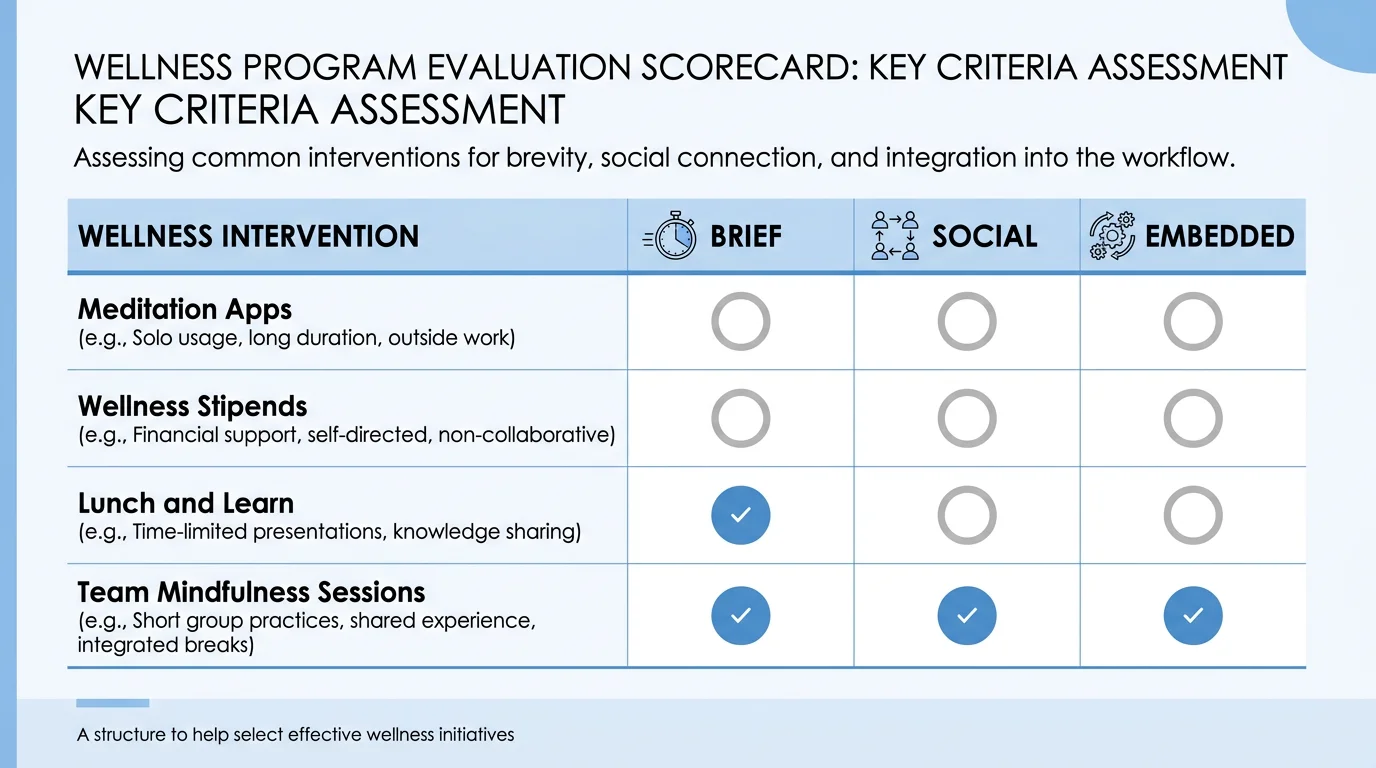
Brief
Does the intervention require less than 10 minutes per session? The JAMA data shows that 5-10 minutes of daily practice delivers large effect sizes for stress reduction. Programs that require 30-60 minute commitments have dramatically lower adherence rates. Brief sessions compound over weeks and months. Long sessions create scheduling friction that kills consistency.
Red flag: Any program that requires employees to block 30+ minutes on their calendar will reach a small, self-selecting group, not the burned-out majority who need it most.
Social
Does the intervention happen with other people? Team-based programs outperform individual ones through social accountability, normalized participation, and the neural synchrony effects documented in Yale's Social Cognitive Science lab research. When a team pauses together, it signals collective permission to prioritize mental health. When an individual opens an app alone, it feels like procrastination.
Red flag: Any program that requires individual opt-in and solo participation will have utilization rates under 10% within 90 days.
Embedded
Does the intervention live inside existing workflows, or does it require employees to create new ones? Calendar-integrated activities have near-100% attendance when other people are involved. Standalone wellness apps have a 95% abandonment rate within 30 days. The difference is not about the content. It is about the behavioral architecture.
Red flag: Any program that requires employees to download a new app, create a new account, or find time outside their existing schedule is building on a foundation the research says will collapse.
Applying the framework
Run your current wellness spending through the BSE filter. For each line item, ask: Is it brief? Is it social? Is it embedded? Programs that score zero or one out of three are almost certainly underperforming. Programs that score three out of three are where the evidence says to concentrate your budget.
| Intervention | Brief | Social | Embedded | BSE Score |
|---|---|---|---|---|
| Meditation app licenses | Yes | No | No | 1/3 |
| Wellness stipends | Varies | No | No | 0-1/3 |
| Quarterly wellness workshops | No | Yes | No | 1/3 |
| Annual offsite retreats | No | Yes | No | 1/3 |
| EAP (Employee Assistance Programs) | Varies | No | No | 0-1/3 |
| Team-based 5-min daily sessions | Yes | Yes | Yes | 3/3 |
| Manager training on burnout | Varies | Yes | Partially | 1.5-2/3 |
ROI reality: what you can actually measure
People leaders are under pressure to demonstrate ROI on wellness spend. Here is an honest accounting of what the research says you can and cannot measure.
What you can measure
Perceived stress reduction. The JAMA/UCSF study demonstrated a 27% reduction in perceived stress using validated instruments (Perceived Stress Scale). This is a reliable, standardized metric you can track with pre/post surveys.
Burnout scores. Using the Maslach Burnout Inventory or similar validated instruments, you can measure exhaustion, cynicism, and professional efficacy over time. The UCSF data showed meaningful improvement (d = 0.39) sustained at four months.
Engagement. Gallup's Q12 survey provides a standardized engagement metric. Team-based wellness interventions have been associated with improved engagement scores, particularly on items related to connection and feeling cared about.
Utilization and adherence. Unlike individual app usage (which vendors report in flattering terms), calendar-based team sessions produce clear attendance data. You know exactly who participated and how often.
What you should expect
Be realistic. The NBER Illinois study is a useful corrective for anyone promising transformative ROI. Wellness programs, even good ones, do not dramatically reduce healthcare costs in the short term. They do not eliminate absenteeism. They are not a substitute for addressing workload, management quality, or organizational design.
What good programs do deliver: meaningful, measurable reductions in stress and burnout, improved team engagement, and signals to employees that the organization takes their wellbeing seriously. Over time, these factors contribute to retention, performance, and culture, but the causal chain is longer than most vendors' sales decks suggest.
The honest pitch for evidence-based wellness is not "this will save you $3 for every $1 spent." It is "this is the only category of intervention that has randomized controlled trial evidence of reducing burnout, and it costs a fraction of what you're spending on programs that don't work."
The 2026 wellness buyer's guide
If you are evaluating wellness vendors this year, here is what to look for and what to avoid.
What to look for
Published utilization data. Not "accounts created" or "sessions available." Ask for monthly active usage rates at 90 days. Any vendor that resists sharing this number is hiding something. If the answer is below 15%, the program is not working at scale regardless of its clinical evidence.
Team-level deployment. Programs designed for teams outperform programs designed for individuals. Ask whether the intervention is consumed solo or collectively. If it requires each employee to independently build a new habit, the behavioral science predicts failure.
Calendar integration. The most effective interventions are the ones that live where work already happens. If the program requires employees to leave their workflow, open a separate platform, and carve out time, it is adding friction to an already overloaded day.
Validated outcome measures. Look for vendors who measure outcomes using standardized instruments (PSS, MBI, PHQ-9, GAD-7) rather than proprietary "wellness scores" that cannot be compared across studies or benchmarked against published research.
What to avoid
Vendors who lead with content volume. "10,000 hours of wellness content" is not a feature. It is a decision-fatigue trap. The research shows that simple, consistent, brief interventions outperform content libraries. More options do not produce more usage. They produce more overwhelm.
"Engagement platform" positioning. Wellness platforms that function primarily as another internal communications tool (with feeds, badges, challenges, and social features) are building engagement with the platform, not with the wellness practice. Ask whether the tool delivers the actual intervention or merely facilitates access to one.
ROI claims based on observational studies. The NBER Illinois study showed that 84% of positive ROI claims from previous wellness research were ruled out when tested with a rigorous randomized controlled trial. If a vendor's ROI case depends on observational data, it is likely overstated. Ask for RCT-level evidence.
Programs that only help the already-healthy. This is the most insidious failure mode. Many wellness programs are primarily used by employees who are already engaged, already health-conscious, and already managing their stress. The employees at highest risk of burnout are the least likely to opt in to voluntary, individual programs. If a vendor cannot demonstrate reach beyond the already-healthy, their program is deepening wellness inequality within your organization.
What People leaders should do
If you lead People, Culture, or HR at your organization, here is the action plan the research supports:
Audit your current wellness spend against the BSE framework. List every wellness line item. Score each one: Brief? Social? Embedded? Anything scoring 0-1 out of 3 is a candidate for reallocation. Be honest about utilization rates, not what the vendor reports, but what your employees actually experience.
Shift budget from individual tools to team-based rituals. The evidence is clear that team-level interventions outperform individual ones on adherence, outcomes, and cost-effectiveness. This does not mean eliminating all individual benefits. It means recognizing that your highest-impact dollar goes toward brief, shared practices embedded in existing workflows.
Stop treating wellness as separate from work design. No wellness program can compensate for unsustainable workloads, chronic understaffing, always-on culture, or managers who model burnout. Before adding any new wellness tool, audit the working conditions that make it necessary. Sometimes the best wellness intervention is canceling three recurring meetings.
Measure outcomes, not inputs. Track perceived stress, burnout scores, and engagement at the team level, not just how much you spent or how many licenses you purchased. Run pre/post surveys using validated instruments. Expect modest but meaningful improvements, not miracles. The companies that build sustainable wellness programs are the ones that set honest expectations and track real outcomes over time.
Start small, start now. You do not need a six-month vendor evaluation to begin. Add five minutes of shared silence to the start of your next team meeting. Do it for four weeks. Measure whether the team reports feeling more connected and less stressed. If the answer is yes (and the research says it will be), you have your business case for a scalable solution.
The companies that will actually move the needle on employee wellbeing in 2026 are not the ones that spend the most on wellness. They are the ones that stop buying what looks good in a benefits brochure and start investing in what the evidence says actually works: brief, social, embedded practices that change how teams experience work together.
Pauso brings 5-minute team mindfulness sessions into your existing calendar. No app downloads, no individual accounts, no willpower required. See how it works.
Related Articles


Give your team a shared breath
Pauso joins your Zoom, Meet, or Teams call and guides a 5-minute breathwork session. No apps, no setup, flat price per team.
See plans →